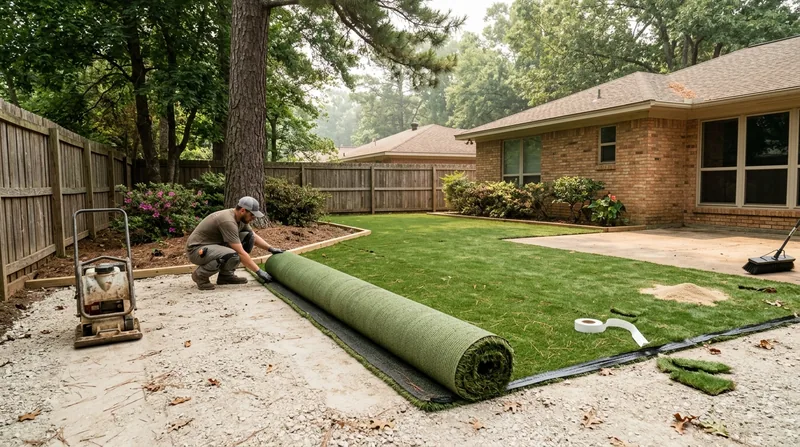




Residential artificial grass installation in Tyler transforms backyards across the Piney Woods into year-round green spaces without the burden of Bermuda or centipede lawns thinning under tall pines. Tyler homeowners face a unique landscape challenge: sandy loam over sticky red clay, heavy spring thunderstorms that pool water in low spots, and pine needles blanketing yards every fall. A healthy natural lawn requires constant work in this climate, especially in shade. Artificial turf offers a low-maintenance alternative that stays green through the heat and humidity of East Texas summers while eliminating the seasonal struggle with pine debris and drainage issues. Whether your yard sits in the historic Azalea District near the Tyler Rose Garden, in the wooded mid-town ranches, or in the newer subdivisions spreading into Whitehouse and Bullard, we install turf that matches your home's character and your family's lifestyle. Since 2013, we've been specifying turf by face weight, pile height, and infill type, not selling generic 40-ounce product on bare dirt.
Why Residential Artificial Grass Installation Matters in Tyler's Climate and Soil
Tyler's rolling terrain, dense tree canopy, and heavy clay base make natural lawn maintenance a year-round struggle. Summer heat and humidity stress Bermuda grass, shade under oaks kills grass entirely, and the annual pine needle drop creates a carpet that smothers new growth. Spring thunderstorms leave standing water in yards with poor drainage, and the acidic soil from decomposing pine needles shifts pH balance. Artificial turf eliminates these seasonal failures and turns problem areas into functional green space.
- Turf stays green and dense year-round without fertilizer, fungicide, or seasonal dormancy.
- Shade areas under oaks and pines that kill real grass become usable, attractive lawn.
- Proper base prep and drainage prevent the pooling and mud that plague clay-heavy yards after heavy rain.
- No pine needle cleanup, no thinning from acidic soil, no seasonal seeding or overseeding.
- Turf installation is not subject to the HOA architectural review that often governs front-yard landscaping changes, though rear yards and side yards are typically unrestricted.
These advantages make artificial turf a practical choice for busy families, retirees, and anyone tired of fighting Tyler's climate and soil chemistry.
Key info: Many Tyler homeowners discover that shade under mature oaks and pines is the real limitation of natural grass, not just watering. Artificial turf solves that problem permanently. Check with your HOA before installing in the front yard, but rear and side yards rarely face restrictions. We help with HOA submittals if needed.
For more details on how artificial turf fits into your specific yard, see our pet turf and dog run installation page if you have dogs, or visit our homepage to learn how we approach every job.
How We Install Residential Artificial Grass in Tyler: Our Process
Artificial turf installation is not a one-day roll-out. We start with a site inspection to assess drainage, tree cover, soil condition, and any HOA restrictions. We then remove existing sod or concrete, grade the yard to proper slope for water runoff, install a perforated base layer, compact it to spec, and lay turf with seams sealed and edges secured. The entire process takes three to five business days for a typical residential yard, depending on yard size, existing hardscape, and soil conditions.
- We inspect the yard for drainage problems, tree roots, and utility lines before any work begins.
- Existing sod or concrete is removed and disposed of; we do not bury or chip it in place.
- The base is graded to slope away from structures and compacted to 95% density for proper drainage and durability.
- Turf is laid with staggered seams, sealed with polyurethane adhesive, and secured at edges with landscape spikes or adhesive.
- We rake the infill into the pile and ensure the surface is even and free of wrinkles or high spots.
This methodical approach prevents the common failures we see from rushed installations: seams that separate, edges that lift, and poor drainage that turns the yard into a swamp after rain.
Example: A homeowner in Bullard had a shaded north-side yard where Bermuda grass had thinned to bare patches. After we removed the dead sod, we found the drainage slope was inverted, pushing water toward the house. We regraded the yard away from the foundation, installed a 4-inch compacted base with perforated drainage board, and laid 65-ounce polyethylene turf with zeolite-based infill. Two years later, the yard drains perfectly and looks as full as day one.
Learn more about our approach to turf removal and replacement if you're converting from a failing natural lawn.
Installation Methods and Materials: What Works Best for Tyler Yards
| Approach | Description | Best for |
|---|---|---|
| Perforated Base with Drainage Board | 4 to 6 inches of compacted base rock plus perforated landscape fabric and drainage board for water runoff. | Yards with clay soil, poor natural drainage, or heavy spring rain. Standard for Tyler residential. |
| Concrete or Patio Base | Turf laid directly over existing concrete, asphalt, or paver surface with perforated underlayment and proper slope for drainage. | Patios, pool decks, balconies, and areas where digging is not practical or desired. |
| Slope and Contour Grading | Custom grading to create landscape features, level out depressions, or improve sight lines while maintaining proper drainage pitch. | Yards with uneven terrain, pooling water, or homeowners wanting to reshape the landscape. |
| Polyethylene vs. Nylon Turf | Polyethylene is softer, cooler, and ideal for families and pets. Nylon is more durable for high-traffic areas and sports use. | Polyethylene for most Tyler residential yards; nylon for playgrounds, dog runs, or sports courts. |
| Infill Selection | Silica sand, recycled rubber, or antimicrobial zeolite infill chosen based on drainage, pet use, and maintenance preference. | Silica sand for general use; zeolite for pet yards; recycled rubber for sports and gym applications. |
Each approach is tailored to your yard's soil, drainage, tree cover, and intended use. We specify the turf product, face weight, pile height, and infill pounds per square foot in writing before work begins, so you know exactly what you are getting.
Residential Artificial Grass Installation Cost in Tyler: What to Expect
Artificial turf installation costs depend on yard size, existing site conditions, tree cover, and the turf product chosen. We price from $8 per square foot as a starting point for standard residential installations with proper base prep and mid-range turf. Smaller yards, complex grading, tree removal, drainage corrections, or premium turf products move the cost higher. A typical 1,000-square-foot residential yard in Tyler runs between $8,000 and $12,000 installed, including base prep, turf, seams, and edges.
- Yard size is the primary cost driver: larger yards benefit from lower per-square-foot pricing.
- Base prep complexity raises cost if grading, drainage correction, or tree root removal is needed.
- Tree cover and shade do not increase installation cost but may affect turf product choice and long-term performance.
- HOA-compliant turf colors and pile heights may carry a small premium over standard options.
- Existing concrete, asphalt, or paver surfaces lower cost compared to full soil removal and base installation.
We always recommend getting two or three estimates from local turf installation companies so you can compare scope, materials, and price. Our estimate is free, includes a written spec of the turf product and base depth, and carries no obligation to book. Call us at (430) 247-2642 or visit our pricing page for more detail on what moves costs up or down for your specific project.
Real example: A 600-square-foot backyard in Tyler with poor drainage and compacted clay cost $5,400 installed. The homeowner chose a 60-ounce polyethylene turf with zeolite infill, we installed a 5-inch compacted base with drainage board, and the yard now stays dry after heavy rain. A 1,200-square-foot yard in Whitehouse with existing sod removal and standard Bermuda-colored turf cost $10,200. Both jobs included free estimates and were completed within five business days.
What to Look for When Hiring a Turf Installation Company Near Me in Tyler
Not all turf installers are equal. Some lay 40-ounce turf on bare dirt and leave, while others cut corners on base prep, seams, or drainage. When you are evaluating a turf installation company near Tyler, ask for proof of insurance, a written specification of the turf product and base depth, local references, and photos of finished work. Check whether the company has a local address and phone number, not a toll-free number or out-of-state office. Ask how long they have been in business and whether they handle repair and seam work if needed down the road.
- Request a certificate of insurance naming general liability and workers compensation coverage.
- Ask for a written spec that names the turf product, face weight, pile height, infill type and pounds per square foot, and base depth.
- Call references and ask about drainage performance, seam durability, and whether the company stands behind the work.
- Ask about HOA submission and approval process if your yard is in a restricted community.
- Confirm that the company handles seam repair and edge lift if those issues arise after installation.
- Get at least two estimates so you can compare scope, materials, timeline, and price.
A reputable turf installation company will answer these questions directly and provide documentation without hesitation. If a company refuses to name the turf product, won't provide references, or quotes a price without an on-site inspection, walk away.
Ready to move forward? Contact us for a free estimate or call (430) 247-2642 to discuss your yard and get a written spec before any commitment.
Residential Artificial Grass Installation in Tyler: Pricing Guide
| Service | Price | Details |
|---|---|---|
| Standard residential yard (up to 1,000 sq ft) | Starting at $8/sq ft | Includes base prep, turf, seams, edges, and cleanup. Clay soil or poor drainage may require additional base work. |
| Small or accent area (under 300 sq ft) | Starting at $9/sq ft | Smaller projects carry higher per-square-foot pricing due to fixed setup and equipment costs regardless of area. |
| Large yard or complex grading (over 1,500 sq ft) | Starting at $7.50/sq ft | Economies of scale apply. Drainage correction, tree root removal, or slope regrading added as line items on estimate. |
| Concrete or patio base installation | Starting at $7/sq ft | Turf over existing hard surface costs less than full soil removal and base prep. Underlayment and drainage setup included. |
| Free estimate | No charge | Site inspection, written spec, and pricing delivered within 24 hours. No obligation to book. Call (430) 247-2642. |
Indicative pricing, the exact cost depends on square footage, finish, and site access. Free personalized estimate within 24h at (430) 247-2642.


